Healthcare Supply Chain
NatPharm Moves to Track Every Consignment. Here's What It Changes.
NatPharm is testing an electronic, serialised tracking system to monitor public medicines from supplier delivery through facility receipt.
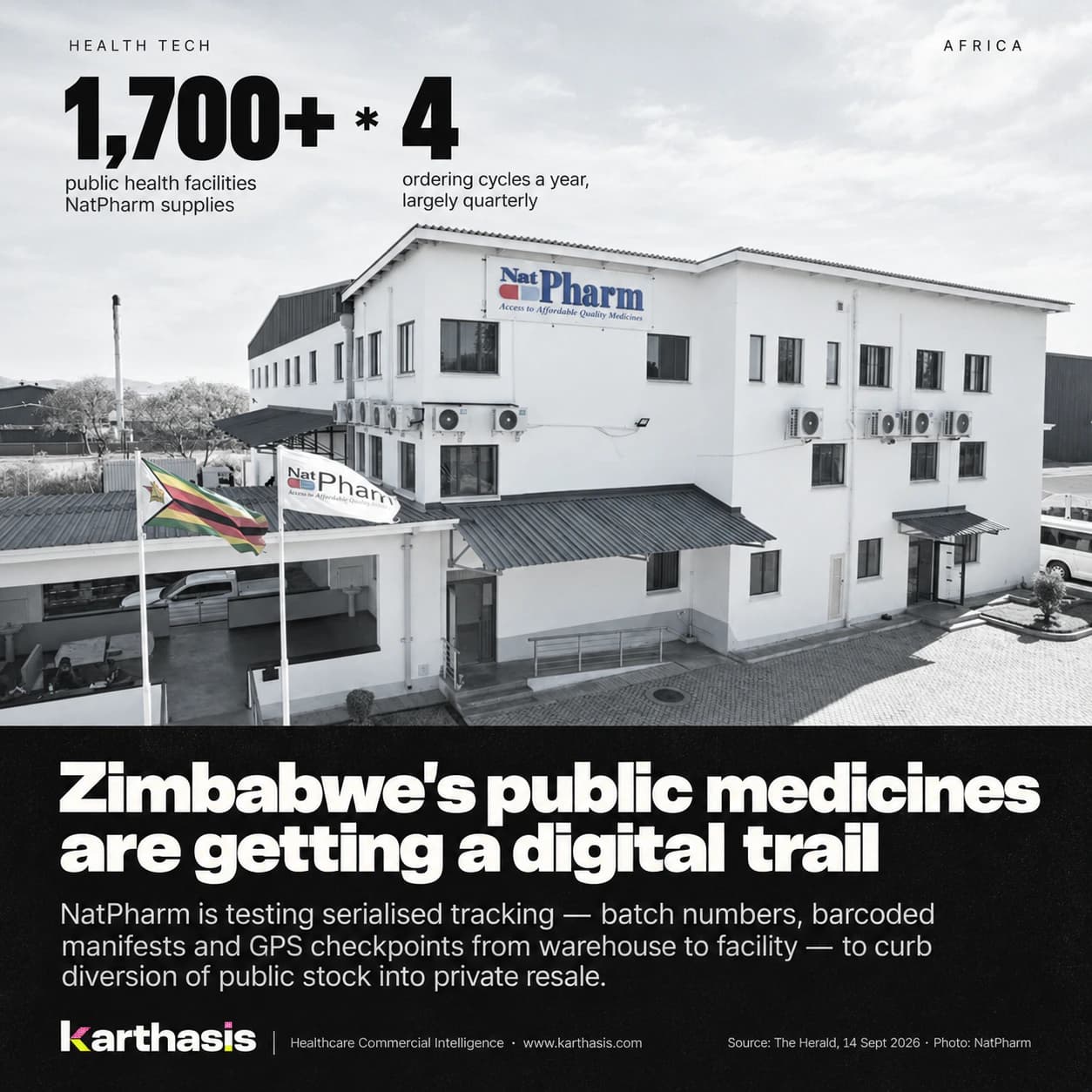
Until now, Zimbabwe's public medicine supply chain had a blind spot. Once a consignment left a NatPharm depot, there was no batch-level record of where it went or whether it arrived in full. NatPharm now plans to close that gap. As The Herald reported on 14 September, the state distributor is testing an electronic, serialised tracking system ahead of a pilot. Its stated aim is to curb diversion and pilferage, including public medicines ending up in private resale.
Every handover becomes a scan
The design is simple: every point where medicines change hands gets an electronic check.
- Supplier delivery. Stock is recorded against the purchase order, including batch numbers and registration details.
- Picking. Orders for facilities are scanned item by item and independently verified before sealing.
- Dispatch. Each sealed consignment carries its own barcode and a digital manifest tied to the vehicle, driver and destination.
- Receipt. Facility staff scan what arrives and confirm receipt, which closes the loop.
Along the way, the system logs GPS-timestamped movement and, where sensors are fitted, cold-chain data. A consignment that arrives short, runs late, leaves its route or is never scanned in gets flagged automatically, rather than surfacing weeks later in a stock count. In NatPharm's warehouses, managing director Newman Madzikwa said, there will be "no such thing as an untracked shelf."
What it changes for industry
For suppliers, paperwork becomes data. Batch, quantity and registration details are checked electronically at intake. Errors and over-deliveries get caught at the gate instead of being reconciled later, so clean documentation becomes part of being a dependable NatPharm supplier.
For the private market, the grey channel narrows. Once the system is live, a public-sector batch found on a private shelf will have a dispatch record pointing back to the facility it was sent to.
For recalls, response gets faster. Medicines under regulatory concern can be electronically suspended so they cannot be picked or dispatched. This month's MCAZ recall shows why that matters: it covered nine batches of nifedipine and levodopa/carbidopa made by Remedica. In a batch-tracked chain, finding affected stock is a query, not a physical search.
ZimEye
For planning, the data is the real prize. NatPharm supplies more than 1,700 public health facilities, mostly on a quarterly ordering cycle. Linking facility receipts to the Ministry of Health's electronic logistics system should give a near real-time view of consumption. That means shortages show up earlier, and stock sitting idle or nearing expiry can be moved to facilities that will use it.
The hard part is the last scan
The system is only as strong as its weakest checkpoint, which is the receiving facility. NatPharm says wider rollout depends on:
- dependable connectivity or offline-capable devices at facilities,
- phased training for every receiving point, and
- validated pilot data.
It has not yet put a figure on expected savings. Digitising depots is the part NatPharm controls. Getting every receiving point, including remote clinics, to scan every delivery every time is where the system will be proven.
The direction is right, and it matches the regulator's. MCAZ has already published a guideline setting out a framework for the traceability of medical products across the Zimbabwean market. Suppliers, wholesalers and pharmacies that already keep clean batch-level records will adapt fastest. We will be watching the pilot.
Mcaz